EXTERNAL CEPHALIC VERSION (ECV)
Your ECV is scheduled on_________________(date) at _________________AM (time).
You should arrive to Labor and Delivery 2 hours before the procedure at ______AM.
|
Surgery location
|
Address
|
|
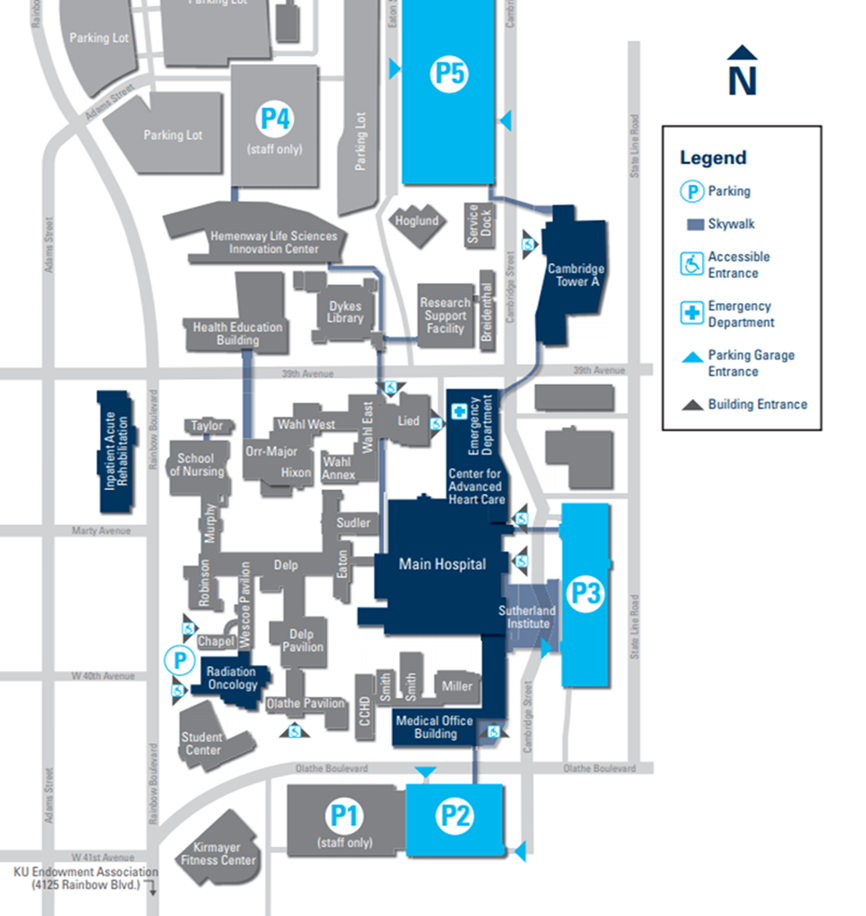
Main Hospital (Bell), 5th floor Unit 54 / Labor & Delivery
|
4000 Cambridge Dr., Kansas City,
KS 66160
|
*See map and parking information on last page of instructions.
Night Before Your Procedure:
-
You may eat and drink as usual until 8 hours before your ECV.
-
Do not eat anything and drink only clear liquids after ________AM/PM, on____________.
-
Do not have anything to drink in the 2 hours before the procedure. Stop drinking at __________ AM. Your procedure will be delayed if this is not followed.
-
Examples of clear liquids are water, apple juice, coffee WITHOUT any milk or creamer, Gatorade or Powerade. You should be able to read a newspaper through clear liquids.
Day of your ECV:
-
Do not eat anything.
-
Remove all jewelry, including body jewelry and piercings, hair pins, contact lenses, dentures, fingernail polish, and hearing aids prior to surgery.
-
Our hospital is a teaching facility, which means we are deeply committed to educating tomorrow’s health care professionals. Therefore, resident physicians will be involved in your care. A resident is a physician who has finished medical school and is receiving training in a specialized area, such as surgery, Obstetrics/Gynecology (OB/GYN), or internal medicine. All our attending doctors are engaged in the supervision and training of resident physicians and feel that it enhances the experience and safety of the care that you receive.
-
Medical students also help in the care of our patients on Labor & Delivery. Medical students on Labor & Delivery have typically completed 2-3 years of medical school.
Arriving to the hospital for your ECV:
-
Go to Labor and Delivery (Unit 54) on the 5th floor of the main hospital 2 hours before your scheduled ECV. Check in with the security desk. Tell them your name and that you are here for an ECV. All visitors over the age of 16 must have photo identification.
-
You will meet the OB and anesthesiology teams. They talk in detail about the procedure and ask you to sign consent forms.
-
You will have an IV placed and labs drawn.
-
We will monitor your baby’s heart rate (called a non-stress test) and perform ultrasound to check the position of your baby.
During the ECV Procedure:
-
It may be recommended that you receive regional anesthesia in the form of spinal anesthesia or an epidural. This has been shown to increase the chances of successfully turning your baby. After this, you will start to feel numb from your breasts to your toes.
-
You may receive a medication called Terbutaline to help relax your uterus and prevent contractions. This has also been shown to increase the chances of successfully turning your baby.
-
A nurse may place wraps (compression devices) on your legs to prevent blood clots and may place a catheter in your bladder to drain urine.
-
Only one adult support person is allowed in the operating room during your procedure. This person will wear disposable scrubs over their clothes while in the operating room.
-
In cases of an emergency, your support person will be asked to step out of the operating room.
-
Your baby’s heart rate will be monitored periodically during the procedure.
After the Procedure:
-
After the procedure, you will be in a recovery room for 2-4 hours to monitor fetal status.
-
After your recovery is complete you will be discharged unless you have made a plan for delivery with your doctor on the same day.
Frequently Asked Questions
What is an ECV?
When should the ECV be performed?
Do I have to have an epidural?
How successful is an ECV?
What are the risks of ECV?
-
The overall complication rate is about 6% with the biggest risk being transient changes in the fetal heart rate. The following rare risks occur less than 1% of the time: emergency c-section, vaginal bleeding, rupture of membranes, placental abruption (separation of the placenta from the uterine wall), cord prolapse, fetal death.
Will I go home after my ECV if it is successful?
-
Staying in the hospital after an ECV depends on how far along in the pregnancy you are and other medical conditions that may warrant delivery.
-
In general, if your ECV is scheduled before 39 weeks, you will go home after the procedure.
-
In general, if your ECV is scheduled at 39 weeks, it is often recommended that you stay for induction after 39 weeks to decrease the chance of the baby turning back to breech. Patients ultimately decide if they want to stay for an induction after an ECV at 39 weeks.
What happens if the ECV is unsuccessful?
-
If the ECV is unsuccessful, next steps depend on how far along in the pregnancy you are and other medical conditions that may warrant delivery.
-
If it is not time for delivery, you will be monitored and then discharged home. There is still a small chance that the baby could flip on its own.
-
If it is time for delivery or delivery is indicated, you will undergo a c-section during your hospital stay. We do not recommend breech vaginal deliveries.
If you have any questions, please call Labor and Delivery at (913)-588-5450.