INTERVENTIONAL RADIOLOGY DISCHARGE INSTRUCTIONS
PERCUTANEOUS NEPHROSTOMY CATHETER
A nephrostomy tube or catheter is a thin tube placed percutaneously (through your skin) and into your kidney to drain urine. Placement of a nephrostomy tube may be necessary due to a blockage or hole in your urinary tract which may be caused by a kidney stone, scar tissue, tumor or infection. In some cases, tubes must be placed in both kidneys. The tube will be connected to a urinary collection bag and depending on your condition you may still need to urinate normally. In cases where the tube or tubes must be left in for a long period of time, they should be changed every 2-3 months or as directed by your doctor.
POST-PROCEDURE PAIN:
- Pain control following your procedure is a priority for both you and your Physicians.
- Some soreness or tenderness at the site is to be expected for several days. We recommend taking over the counter analgesics to help relieve this pain.
- Alternative methods for pain relief include but not limited to heat or cold compress, relaxation techniques, rest, and changing of positions.
- If pain continues after 5-7 days or you have severe pain not relieved by medication, please contact us as directed below.
POST-PROCEDURE ACTIVITY:
- A responsible adult must drive you home.
- If you receive sedation, narcotic pain medication or anesthesia for the procedure, you should not drive or operate heavy machinery or do anything that requires concentration for at least 24 hours after procedure completion.
- It is recommended that a responsible adult be with you until morning.
- Avoid any strenuous activity that may affect the catheter. Avoid pushing, pulling or straining.
- Do not lift more than 5 lbs. for one week.
- Avoid any activity that causes tension or pulling on the catheter and avoid bending or crimping the tube. Never use scissors, pins or other sharp objects near the tube.
- During your first few days, your urine will be somewhat bloody or blood-tinged, however this should gradually clear over 2-3 days.
POST-PROCEDURE SITE CARE:
Care instructions for the first two weeks:
- You will have a bandage around the tube site. Keep this clean and dry.
- Always wash your hands thoroughly before handling the tube or touching near the procedure site.
- For the first two weeks after placement, the bandage around the tube should be changed every 2 days or if it becomes wet or soiled.
- Start by cleaning in a circular motion around the tube site with mild soap and clean gauze. Work outward 3-4 inches.
- Rinse with saline or water and gently pat dry with clean gauze.
- Place dry gauze around the tube and secure bandage and tube with tape or an occlusive dressing such as tegaderm™.
- You may shower but you must cover the tube site carefully with plastic wrap to keep dry. Ensure the tube is secured and does not tug at the site. Otherwise you may take sponge baths, taking care to keep the bandage/tube site dry.
Care instructions after two weeks:
- Remove the bandage before showering and shower with the bandage off.
- How to clean in the shower:
- Ensure the tube is secured and does not tug at the site.
- Clean around the tube site gently with mild soap and water.
- After you shower, dry gently around the tube site.
- Place clean, dry gauze around the tube site and secure with tape.
Other instructions:
- You will be provided with an initial supply kit and resources to obtain additional dressings and drainage bags.
- You will receive a prescription for pre-filled saline syringes.
- Wash your hands before and after emptying the drainage bag.
- Never submerge the tube or tube site underwater (no bathtub, swimming, hot tub, etc.)
- Do not use ointments, creams or powders around the tube site unless specifically ordered by your doctor.
DRAINAGE BAG CARE:
- Always keep the drainage bag lower than the level of your bladder.
- Empty your drainage bag as often as needed or at least when it 2/3 full.
- Write down the daily output of your drain. Subtract the total amount of saline used for flushing. When the amount of drainage drops to less than 10-15 mL per day, it will be time to have the drain reassessed. Be sure to notify your doctor when this happens.
- Change the bag every 2 weeks. You will be provided with a supply kit.
- Always wash your hands thoroughly before changing the bag.
To change the bag:
- Swab tubing with alcohol where it connects to the bag.
- Disconnect the drainage bag from the tube. Discard the used bag.
- Swab the end of the tubing again with alcohol.
- Connect the new bag.
- Secure the drainage bag to calf, thigh or waist with straps which are provided with each new drainage bag.
FLUSHING THE CATHETER:
Your physician may direct you to flush your nephrostomy tube. Always wash your hands thoroughly before flushing. Your catheter should be flushed as instructed by your provider.
If you feel pressure or resistance when flushing, stop. Do not try to force the saline to flush. Call your doctor right away.
The drain will be equipped with a 3-way stopcock, a flush adapter, or it will be capped. Instructions for flushing these different types are described below.
Stopcock Flushing:
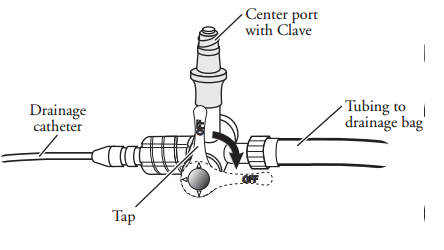
- Turn the stopcock off to the drainage bag.
- Clean the flushing port with an alcohol wipe for 30 seconds.
- Attach the flush syringe.
- Gently inject the saline and remove the syringe.
- Turn the stopcock off to the flushing port and open to the drainage bag.
Flush Adaptor Flushing:
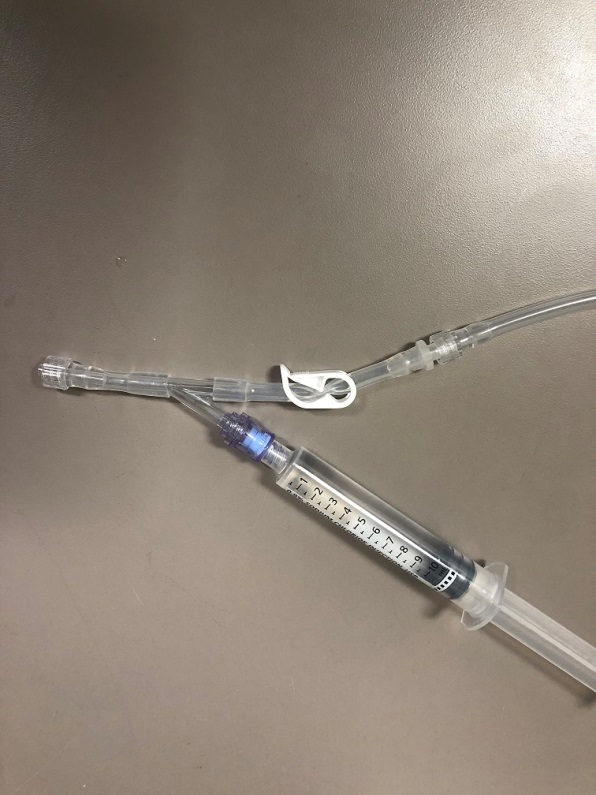
- Clamp the tubing.
- Clean the flushing port with an alcohol wipe for 30 seconds.
- Attach the flush syringe. Gently inject the saline and remove the syringe. Unclamp the tube.
Flushing the catheter when capped:
- The tube will be capped with a blue needleless connector.
- Swab the end of the tube with alcohol for 30 seconds and then attach the pre-filled saline syringe.
- Inject the saline and remove the syringe.
DIET/MEDICATIONS:
- You may resume your previous diet after the procedure.
- If you receive sedation or narcotic pain medications, avoid any foods or beverages containing alcohol for at least 24 hours after the procedure.
- Please see the Medication Reconciliation sheet for instructions regarding resuming your home medications.
CALL THE DOCTOR IF:
- You have new or worsened back, groin or belly pain.
- There is tenderness or drainage around the tube site.
- You have cloudy urine or foul smelling urine.
- You have urine leaking around the tube site.
- You have bleeding at the tube site or bright red blood in the tube or bag after 1-2 days.
- You have little or no urine draining. Check first for kinks in the tubing. Call your doctor if there are no kinks seen and urine is not draining.
- The tube has moved out of place where it enters your skin. Do not try to push the tube back inside. Secure the tube with tape and call the doctor.
- The tube comes out. Cover the area with a bandage and call the doctor immediately.
- You have pain not relieved by medication. Some soreness at the site is to be expected for several days after tube placement.
- You have signs of infection such as: fever greater than 101F, chills, redness, warmth, swelling, drainage or pus around the tube site.
For further education regarding your drain, please watch the following video with this link:
https://youtu.be/1XWu0A0qxLY

For any of the above symptoms or for problems or concerns related to the procedure, call 913-588-4846 Monday-Friday from 7-5p. After-hours and weekends, please call 913-588-5000 and ask for the Interventional Radiology Resident on-call.
You or your caregiver should call 911 for any severe symptoms such as excessive bleeding, severe dizziness, trouble breathing or loss of consciousness.
|
Drainage
|
|
Date
|
Time
|
Amount
|
|
|
|
|
|
|
|
|
|
|
|
|
|
|
|
|
|
|
|
|
|
|
|
|
|
|
|
|
|
|
|
|
|
|
|
|
|
|
|
|
|
|
|
|
|
|
|
|
|
|
|
|
|
|
|
|
|
|
|
|
|
|
|
|
|
|
|
|